
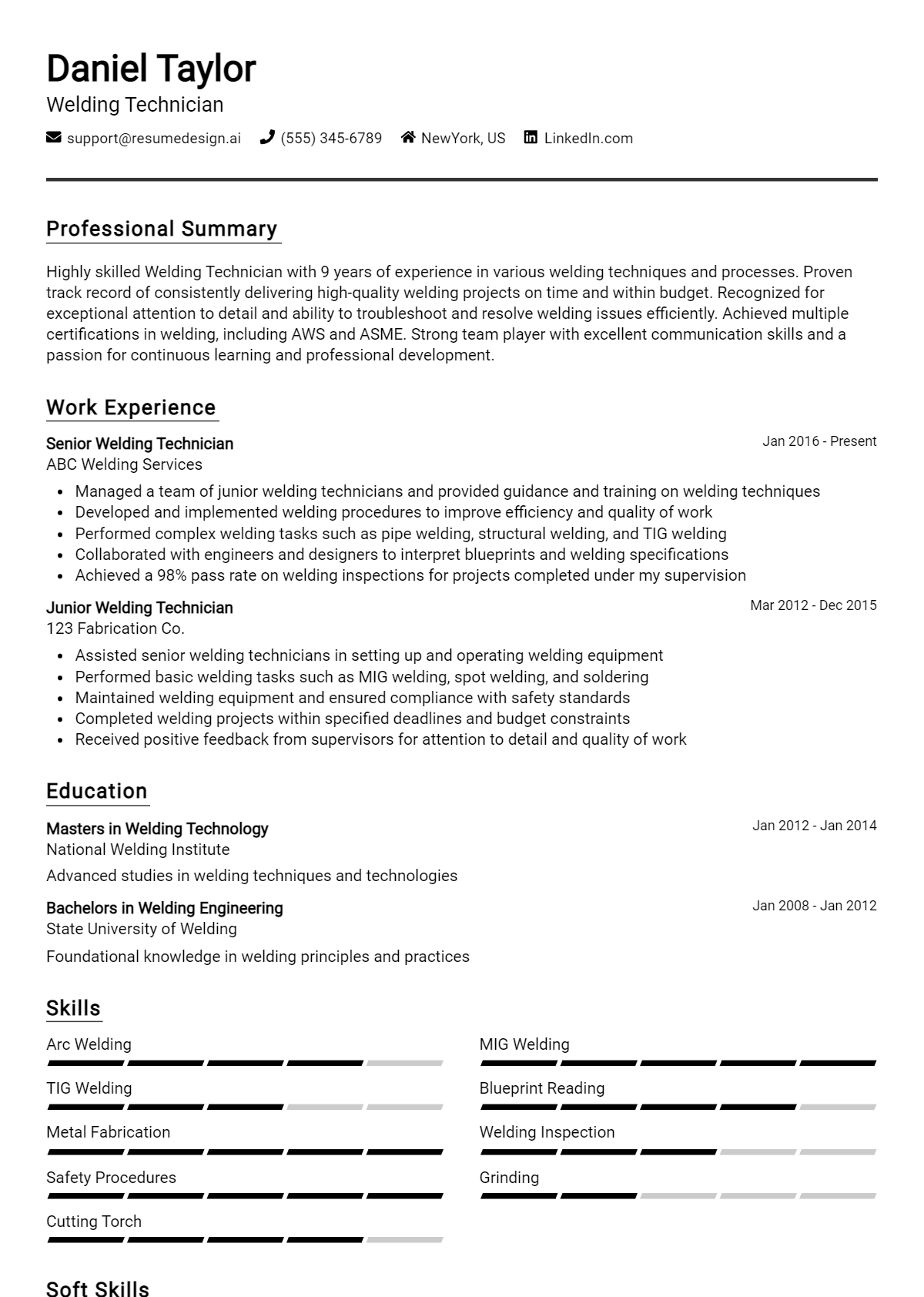
As a beginner in the welding industry, you're likely to face stiff competition for entry-level positions. A well-crafted resume can make all the difference in helping you stand out from the crowd and landing an interview. In this article, we'll provide you with practical tips and a welding resume template to help you create a strong resume that showcases your skills and experience.
Understanding the Basics of a Welding Resume
Before we dive into the template, it's essential to understand the basics of a welding resume. A good welding resume should highlight your technical skills, certifications, and experience in the field. As a beginner, you may not have extensive experience, but you can still showcase your education, training, and any relevant projects or internships.
Key Components of a Welding Resume
Contact Information: Include your name, address, phone number, and email address.
Professional Summary: A brief overview of your experience, skills, and career goals.
Education and Training: List any relevant education or training programs, including certifications and diplomas.
Technical Skills: List your technical skills, including welding processes, equipment, and software.
Work Experience: List any relevant work experience, including internships and volunteer work.
Certifications and Licenses: List any relevant certifications or licenses, including AWS or ASME certifications.
Choosing the Right Welding Resume Template
When choosing a welding resume template, look for one that's clean, concise, and easy to read. Avoid templates with too much clutter or unnecessary graphics. A simple template with clear headings and bullet points is best.
Resume Template Example
Here's an example of a welding resume template for beginners:
[Your Name]
[Address]
[Phone Number]
[Email Address]
Professional Summary:
Highly motivated and detail-oriented beginner welder with [number] hours of training and [number] certifications. Proficient in [welding process] and [equipment]. Seeking an entry-level position in a dynamic and growing company.
Education and Training:
Welding Training Program, [Name of School], [Graduation Date]
Certified Welding Inspection, [Certification Date]
Technical Skills:
Welding Processes: MIG, TIG, Stick
Equipment: Lincoln Electric, Miller Electric
Software: Autodesk Inventor
Work Experience:
Welding Intern, [Company Name], [Employment Dates]
+ Assisted senior welders with fabrication projects
+ Learned and practiced various welding techniques
+ Developed strong attention to detail and quality control skills
Certifications and Licenses:
AWS Certified Welder, [Certification Date]
ASME Welding Certification, [Certification Date]

Tailoring Your Resume to the Job Description
When applying for a welding job, it's essential to tailor your resume to the job description. Study the job description and requirements, and make sure your resume highlights the skills and experience that match the job.
Job Description Example
Here's an example of a welding job description:
Job Title: Entry-Level Welder
Job Summary:
We're seeking a highly motivated and detail-oriented entry-level welder to join our team. The ideal candidate will have [number] hours of training and [number] certifications. Proficient in MIG and TIG welding processes.
Tailoring Your Resume
To tailor your resume to this job description, you would:
Highlight your MIG and TIG welding skills in the technical skills section
Emphasize your attention to detail and quality control skills in the professional summary and work experience sections
Include any relevant certifications, such as AWS or ASME certifications
Common Mistakes to Avoid
When creating a welding resume, there are several common mistakes to avoid:
Lack of relevant experience: As a beginner, you may not have extensive experience, but you can still showcase your education, training, and any relevant projects or internships.
Poor formatting: Use a clean and concise template, and avoid clutter or unnecessary graphics.
Typos and grammatical errors: Make sure to proofread your resume multiple times to catch any errors.
Additional Tips and Resources
Use action verbs: Use action verbs like "assisted," "learned," and "developed" to describe your work experience.
Quantify your experience: Use numbers to quantify your experience, such as " [number] hours of training" or "[number] certifications."
Get feedback: Ask a friend or mentor to review your resume and provide feedback.
Resources
American Welding Society (AWS): A great resource for welding professionals, including job listings, training programs, and certifications.
National Institute for Metalworking Skills (NIMS): A non-profit organization that provides training and certification programs for metalworking professionals.
Frequently Asked Questions
Q: What if I don't have any work experience?
As a beginner, you may not have extensive work experience, but you can still showcase your education, training, and any relevant projects or internships.
Q: How do I get certified as a welder?
You can get certified as a welder through various organizations, such as the American Welding Society (AWS) or the National Institute for Metalworking Skills (NIMS).
Q: What if I'm not sure what type of welding job I want?
You can explore different types of welding jobs, such as MIG, TIG, or Stick welding, and tailor your resume and training to the specific job you're interested in.
Final Tips and Next Steps
Creating a strong welding resume takes time and effort, but it's worth it to stand out in the job market and increase your chances of landing an interview. Remember to:
Tailor your resume to the job description
Highlight your technical skills and certifications
Use action verbs and quantify your experience
- Get feedback from friends or mentors
By following these tips and using the welding resume template provided, you'll be well on your way to creating a strong resume that showcases your skills and experience. Good luck in your job search!
Related: free templates for a resume
Related: Travel Checklist Template in Word: What Actually Makes Sense?
